16 September 2010
El orgullo de Nicaragua es azul y blanco
The pride of Nicaragua is blue and white.
This week Nicaragua celebrated its Fiestas Patrias. September 14th is celebrated as the anniversary of the Battle of San Jacinto and the 15th commemorates Nicaraguan independence. To say that the pride of Nicaragua is “azul y blanco” has two meanings. First, the flag with its white strip land, embossed with the nation's famous lakes and volcanoes, set between blue bodies of water to the east and the west is ubiquitous. It is a beautiful flag. The country takes its national symbols seriously. The national bird, tree, and flower are prominently displayed in every school and in most classrooms, and rarely does a month pass that there isn't a special class devoted to showing proper respect for
the national symbols. But I don't really want to
talk about the flag.
The true pride of Nicaragua, and its hope and future, is the other azul y blanco— its students. The Nicaraguan school uniform is, as you've probably guessed, blue and white. To celebrate its independence, Nicaragua makes full use of this resource. The majority of my classes this month were canceled because the students were learning to march, practicing with the band (which is all percussion instruments), learning traditional Caribbean dances, or some other activity in preparation for this week. When the Fiestas finally arrived the whole town gathered in the park to watch all the students from all the public schools march around town to the beat of the band and accompanied by a variety of cultural exhibitions. It was quite a show. I can't imagine a similar event being organized in the united states. The only similarity was the look of disinterest that accompanies forced participation on a hot afternoon evident on a large number of the faces. Compulsion or no compulsion, they all did a great job!
I spend the vast majority of my time working in high schools. The purpose of our class is to help give students the tools and the confidence they need to take their educational and economic future into their own hands. They have the rhetoric down. They can tell you that their future depends on themselves and that they are there to learn how to learn to make the most of the opportunities presented to them and to create there own when it seems like none is available. I believe them to be totally capable of all these things. The test, however, will be to see the way they march and dance and beat the drum when they're no longer dressed in azul y blanco.
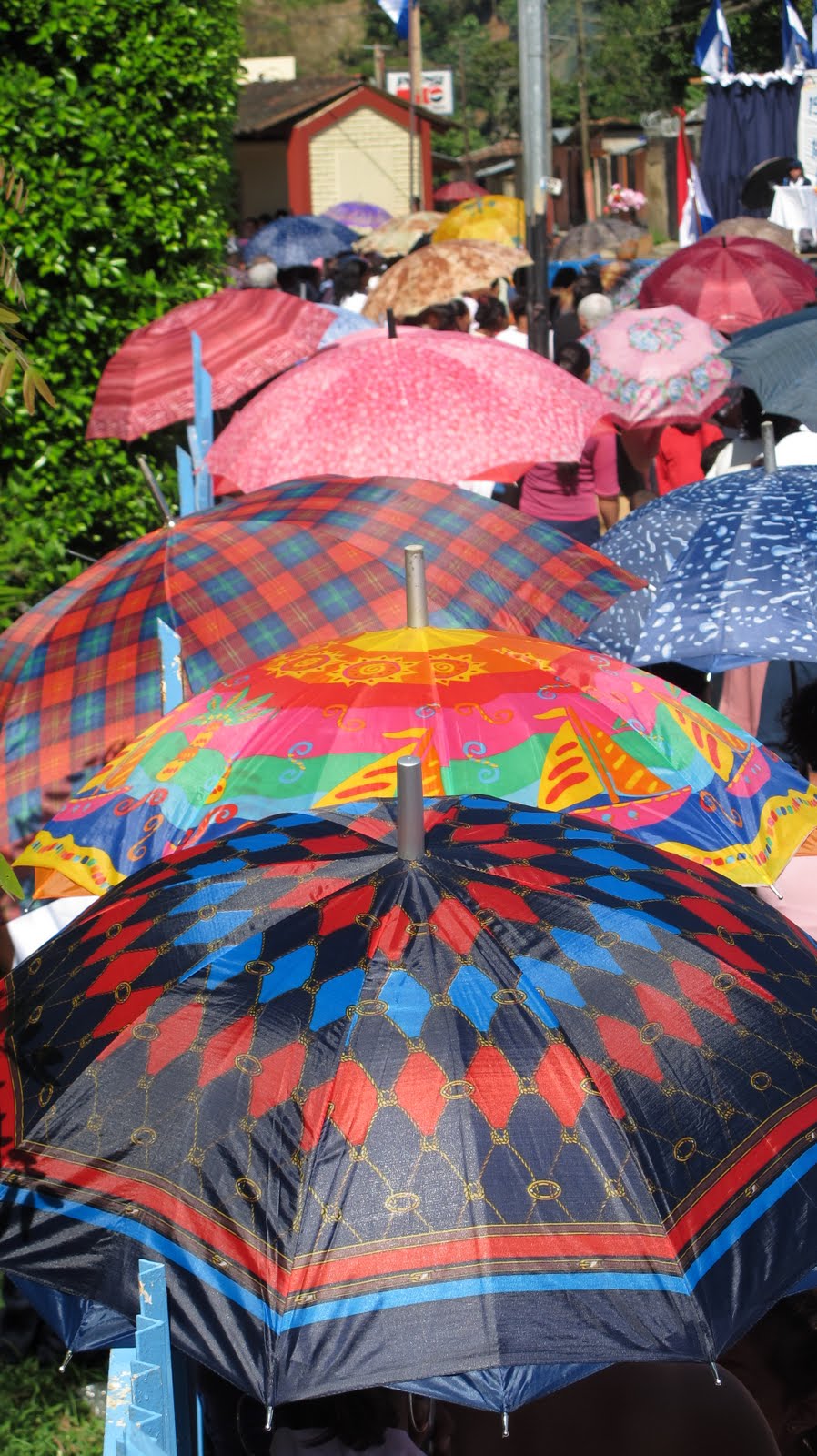
La sombrilla
Sombrilla, sombrillita
arco iris de color
cuidando la viejita
del brillante sol y su calor
Sombrilla, sombrillita
no una paraguas sos
ni parasol de fancesita
porque no podés pararlos vos
Sombrilla, sombrillita
que fresca sombra tirás
sobre lindas chavalitas
en cuyas manos te quedás
Sombrilla, sombrillita
seguí con tu trabajo
sonriendo allá bonita
hasta el sol esté más bajo.
arco iris de color
cuidando la viejita
del brillante sol y su calor
Sombrilla, sombrillita
no una paraguas sos
ni parasol de fancesita
porque no podés pararlos vos
Sombrilla, sombrillita
que fresca sombra tirás
sobre lindas chavalitas
en cuyas manos te quedás
Sombrilla, sombrillita
seguí con tu trabajo
sonriendo allá bonita
hasta el sol esté más bajo.
02 September 2010
1 Septiembre
September is 7 hours and 45 minutes old and I've already watched the sunrise over foggy, rolling hills interspersed with pine trees while listening to the cows say good morning and drinking a cup of sugary coffee cut with milk that I, personally, milked right from the cow into my cup. Maybe it wasn't the best idea, but who could pass up the opportunity to complete that sentence.
Look at Don Francisco's face. He's loving the fact that I want to get up at 4:30 and go learn to milk cows out in the campo. We'd known each other for about three minutes when he first asked me if I wanted to go out to the finca and milk cows (I was drinking a cup of hot milk in his son's house at the time). I said, heck yeah, how about Wednesday. He was also the one that proposed I go take a walk around the hill so I could enjoy the sunrise, that I should take a cup of coffee with me, and that it was only appropriate the I put milk in it right from the cow.
19 August 2010
Cuando llueva... (When it rains)
Today it rained. It very rarely rains all day, nor did it do so today. When the sun rose the skies were clear and blue. When I left school it was downright hot, but the clouds had begun to form. A sudden rise in heat here means two things. First, it means that it's going to rain. More likely than not, it isn't just going to rain it's going to storm. We have beautiful storms here. Second, it means that nobody is gong anywhere. When it rains, nobody leaves their house unless they have to. I'm not sure if this is connected with my earlier observation that Nicas tend not to know how to swim, but I know that if I have a meeting scheduled and it's raining I'm going to be the only one there.
Anyway, today it rained. Luckily, I had only scheduled myself for an afternoon of leisurely planning, so when the first claps of thunder started rumbling and the first relampagos flashed in the distance it wasn't hard to transition into my rainy day routine. Yes, I already have a rainy day routine, and it goes like this. First, I run to the kitchen and put water on to boil. Everybody here loves to drink coffee when it rains. I think it's because they're cold. I don't usually ask questions when people want to drink coffee. Also, most people here either have a finca or have a cousin who has a finca and so they have private coffee sources, café de palo or café puro they call it. It does, however, take awhile to get the water boiling, boil it until it's purified (my chlorine purified water makes horrible coffee... don't even try it), and then get my coffee made. Sometimes it takes longer than the storms, which tend to move in and out pretty quickly, so it is imperative that my first move is to the kitchen. Second, I collect from my room my journal, a few notebooks, and whatever baked good or cajeta that I have stashed away for such occasions. Cajetas are my current go to. My favorites are basically nothing more than shredded coconut and dulce.... a brown sugar-like material made from cane sugar, formed into little bars. They're cheap and delicious. Finally, I retire to my hammock, currently hung in a perfect rain watching spot, strategically positioned to see the rain and take advantage of the breeze coming off the courtyard.
Once I am comfortably settled into my denim hammock (durable, and the mosquitos can't bite you from behind) I adjust my plans away from the first goal of Peace Corps, offering technical assistance in our respective sectors, to the cultural exchange portion of our mandate. As I've already noted, nobody leaves home when it rains. If they do, apparently they come to our home. Today everyone had been out at the finca, so just as I was settling in for the rain storm the whole extended family appeared toting fresh tamales made from new corn (riquísimos!), a new load of plantains, and tons of curiosity about life up north. The rest of my day was therefore: sit in my hammock with my coffee and my cajetas, wait for people to offer me food or sit down and start chatting, and be able to feel perfectly good about it because I'm fulfilling one of the primary goals for which I was sent here.
Anyway, today it rained. Luckily, I had only scheduled myself for an afternoon of leisurely planning, so when the first claps of thunder started rumbling and the first relampagos flashed in the distance it wasn't hard to transition into my rainy day routine. Yes, I already have a rainy day routine, and it goes like this. First, I run to the kitchen and put water on to boil. Everybody here loves to drink coffee when it rains. I think it's because they're cold. I don't usually ask questions when people want to drink coffee. Also, most people here either have a finca or have a cousin who has a finca and so they have private coffee sources, café de palo or café puro they call it. It does, however, take awhile to get the water boiling, boil it until it's purified (my chlorine purified water makes horrible coffee... don't even try it), and then get my coffee made. Sometimes it takes longer than the storms, which tend to move in and out pretty quickly, so it is imperative that my first move is to the kitchen. Second, I collect from my room my journal, a few notebooks, and whatever baked good or cajeta that I have stashed away for such occasions. Cajetas are my current go to. My favorites are basically nothing more than shredded coconut and dulce.... a brown sugar-like material made from cane sugar, formed into little bars. They're cheap and delicious. Finally, I retire to my hammock, currently hung in a perfect rain watching spot, strategically positioned to see the rain and take advantage of the breeze coming off the courtyard.
Once I am comfortably settled into my denim hammock (durable, and the mosquitos can't bite you from behind) I adjust my plans away from the first goal of Peace Corps, offering technical assistance in our respective sectors, to the cultural exchange portion of our mandate. As I've already noted, nobody leaves home when it rains. If they do, apparently they come to our home. Today everyone had been out at the finca, so just as I was settling in for the rain storm the whole extended family appeared toting fresh tamales made from new corn (riquísimos!), a new load of plantains, and tons of curiosity about life up north. The rest of my day was therefore: sit in my hammock with my coffee and my cajetas, wait for people to offer me food or sit down and start chatting, and be able to feel perfectly good about it because I'm fulfilling one of the primary goals for which I was sent here.
10 August 2010
Yo debo (I should)
I've been in site for a few weeks now. I've almost earned the privilege of carrying a camera again.
About Wednesday of this week, I let myself highlight the best of the project ideas I've spent the last three months scribbling in my notebook. That was probably a little premature.
I'm in a new place, shouldn't I be taking pictures? I'm starting two years of work, shouldn't I be planning projects? Maybe. There are definitely pictures that need to be taken and projects that need to be planned. I am not yet, however, the person to address those needs.
Currently, I am in the process of trying to understand my new home. I go to work everyday, some days in one of my schools, others at the Cooperativa. I walk around or buy random things from various ventas as an excuse to talk to their owners, but mostly I sit in the park drinking coffee and talking to strangers. Even now I probably don't do this as much as I should. It may be the most important thing I do in the next two years, not only because my most lasting impact may be the impression I leave about North Americans, but because the success of all my other projects and my ability to tell the story of this place when I leave depend on understanding what this place is, who its people are, what they want, what they have, and finally after all of that, what they might need that I can help them with.
This may be my only chance to do things this way. The jobs that offer you the chance to go live in a place for two years and tell you that its OK, even encouraged, to take the first three to six months to get a feel for the area and its people before starting to work on new projects, are few and far between.
I'm not going to lie, it is hard to take things slow. We want to act. In “we” I include both development workers and people in general. We see things that are different to us: different living standards, different patterns of behavior, different social norms, different faces, different landscapes. We see things that we think are beautiful or horrible. We see things that we wish were different or we wish would never change. So what do we do? We think, “I should do something.” Take a picture. Start a program. Give money. But how do we know what we should do if we don't really understand what is going on?
When I take a picture I don't just capture an image; I create an image. My responsibility as a photographer is to make sure that the image faithfully represents the subject and the situation (check out this entry in Ancora Imparo). When you choose a project you decide to spend energy and resources in a way that means other things go undone. It is my responsibility as a project planner to make sure these are well spent and that they serve the interests and needs of their target population, not my desire to be doing something.
Responsible photography is the perfect reminder for me about responsible development work, or responsible decision making. A good picture is a wonderful thing, worth a thousand words so they say. One you understand very well may be worth that much and more. But a picture you don't understand, be it of something beautiful or tragic, may do more harm than ten thousand words can correct. It cements itself into your thinking about a place or group of people. If you use it to teach others, it provides a distorted perspective to your audience which affects the way they feel and act with respect to people they haven't met and places they have never been.
I do love photos though... here's a few from my first few months.
About Wednesday of this week, I let myself highlight the best of the project ideas I've spent the last three months scribbling in my notebook. That was probably a little premature.
I'm in a new place, shouldn't I be taking pictures? I'm starting two years of work, shouldn't I be planning projects? Maybe. There are definitely pictures that need to be taken and projects that need to be planned. I am not yet, however, the person to address those needs.
Currently, I am in the process of trying to understand my new home. I go to work everyday, some days in one of my schools, others at the Cooperativa. I walk around or buy random things from various ventas as an excuse to talk to their owners, but mostly I sit in the park drinking coffee and talking to strangers. Even now I probably don't do this as much as I should. It may be the most important thing I do in the next two years, not only because my most lasting impact may be the impression I leave about North Americans, but because the success of all my other projects and my ability to tell the story of this place when I leave depend on understanding what this place is, who its people are, what they want, what they have, and finally after all of that, what they might need that I can help them with.
This may be my only chance to do things this way. The jobs that offer you the chance to go live in a place for two years and tell you that its OK, even encouraged, to take the first three to six months to get a feel for the area and its people before starting to work on new projects, are few and far between.
I'm not going to lie, it is hard to take things slow. We want to act. In “we” I include both development workers and people in general. We see things that are different to us: different living standards, different patterns of behavior, different social norms, different faces, different landscapes. We see things that we think are beautiful or horrible. We see things that we wish were different or we wish would never change. So what do we do? We think, “I should do something.” Take a picture. Start a program. Give money. But how do we know what we should do if we don't really understand what is going on?
When I take a picture I don't just capture an image; I create an image. My responsibility as a photographer is to make sure that the image faithfully represents the subject and the situation (check out this entry in Ancora Imparo). When you choose a project you decide to spend energy and resources in a way that means other things go undone. It is my responsibility as a project planner to make sure these are well spent and that they serve the interests and needs of their target population, not my desire to be doing something.
Responsible photography is the perfect reminder for me about responsible development work, or responsible decision making. A good picture is a wonderful thing, worth a thousand words so they say. One you understand very well may be worth that much and more. But a picture you don't understand, be it of something beautiful or tragic, may do more harm than ten thousand words can correct. It cements itself into your thinking about a place or group of people. If you use it to teach others, it provides a distorted perspective to your audience which affects the way they feel and act with respect to people they haven't met and places they have never been.
| Laguna de Apoyo |
| The view from one of my schools |
17 July 2010
Café simple: negro y amargo
This is a story about coffee, a history of my relationship with the beverage, but it is also about cultural sensitivity and adaptation. To me, coffee is a wonderful beverage with many complexities and varied possibilities. From tree to cup, there are many things that can go wrong, but when it all comese together it is a beautiful thing. Cultural adaptation and sensitivity are similar.
My first experience with coffee came at a truck stop when the restaurant accidentily mixed it with my hot chocolate. I was ten. It was a Big Boys, and I believe my little brother Mark stuck his finger in a hollow cheese-stick and got burnt. Years later, I asked for my first cup of coffee voluntarily on a flight to italy. I only drank a few sips and thought it was disgusting. After the airline coffee debacle, my coffee history goes dark for another five years. Then, one fateful night in Fitzhugh 141 I looked up from the paper I was writing and declared, “Ali I need a break. Let's go for a walk; I want a cup of coffee.” it seemed to be the appropriate thing to do late on a thurs/fri. Night for a college student hard at work and in need of a break (regardless of how inappropriate the fact may be that we were writing papers at 10:00 pm on a thurs/fri. Thus, I bought my first cup of coffee from Cross-Roads in O-Hill dining hall at the University of Virginia. I've forgotten exactly what it was, but I know I put about an inch of milk in it, and that it was good. The rest is history. I've drunk a million cups since-- café cortado and café con leche in Peru, straight espresso and café au lait in France, but more than anything else, made in so many different ways I can't even count, my drink has become straight, black coffee.
When I found out I was coming to Nicaragua I was excited for some good coffee. My favorite coffee at home is a fresh brewed cup of Selva Negra Estates, a Nicaraguan coffee grown in Matagalpa, from Shenandoah Joe's in Charlottesville. I was excited because coffee is something I really enjoy, not simply as a beverage but as a cultural practice, as a social medium and as an economic topic. I thought it would be a point on which my new culture and I could mesh, over which we could sit and have a chat. The suprise was then on me when I arrived to find that the overwhelming preference in my pueblo was café instantaneo (instant coffee), and not just instant coffee, but sickeningly sweetened instant coffee. Sometimes they make it with milk instead of water. Having already claimed to love coffee, and being inundated with session after session preaching, “adapt, adapt, adapt!” I smiled and spent my first few weeks drinking maple syrup with my h-mom.
Before you judge this decision, let me go a bit deeper. When we go into a new culture and seek to adapt and be sensitive we are presented with a million and one questions, a million and one decisions to make. Their basic form is this, “What are you going to do here? What are you going to pick up of their ways? What are you going to put down of your own ways?” Changing the way you drink coffee seems to be a fairly innocuous change to make for your new culture. In the last statement, however, lies the mistaken assumption on which the problem of cultural adaptation is built.
Coffee can, in fact, be an innocuous cultural element. When I drank my airline coffee, or that first cup in college, there was a cultural component in my mind that was telling me it was the culturally appropriate thing to do. In one case it didn't stick; I didn't like it; it didn't fit in with me and who I was, so I dropped it. Years later, it did stick; it did fit; and it became a point of interest, comfort, and reliability. When someone offers me a cup of coffee, I always accept and don't turn up my nose because it is super sweetened Presto. It is still an innocuous cultural element, but for exactly that reason it makes no sense to drop my old preferences. Cultural adaptation is not the process of laying aside all you can of one culture to take up another. It is not avoiding sensitive topics or awkward discussions. It is the process of finding a happy, acceptable, sustainable “you” in a new place. Sure, you pick things up and put things down, but you don't put yourself down in the process. The coffee conundrum was easily solved. “I'm going to make coffee; I bought some beans at the store. Would you like some? How do you like your coffee? At home I usually drink mine without and sugar or mild, what would you call that here?”
“Café simple: negro y amargo”
My first experience with coffee came at a truck stop when the restaurant accidentily mixed it with my hot chocolate. I was ten. It was a Big Boys, and I believe my little brother Mark stuck his finger in a hollow cheese-stick and got burnt. Years later, I asked for my first cup of coffee voluntarily on a flight to italy. I only drank a few sips and thought it was disgusting. After the airline coffee debacle, my coffee history goes dark for another five years. Then, one fateful night in Fitzhugh 141 I looked up from the paper I was writing and declared, “Ali I need a break. Let's go for a walk; I want a cup of coffee.” it seemed to be the appropriate thing to do late on a thurs/fri. Night for a college student hard at work and in need of a break (regardless of how inappropriate the fact may be that we were writing papers at 10:00 pm on a thurs/fri. Thus, I bought my first cup of coffee from Cross-Roads in O-Hill dining hall at the University of Virginia. I've forgotten exactly what it was, but I know I put about an inch of milk in it, and that it was good. The rest is history. I've drunk a million cups since-- café cortado and café con leche in Peru, straight espresso and café au lait in France, but more than anything else, made in so many different ways I can't even count, my drink has become straight, black coffee.
When I found out I was coming to Nicaragua I was excited for some good coffee. My favorite coffee at home is a fresh brewed cup of Selva Negra Estates, a Nicaraguan coffee grown in Matagalpa, from Shenandoah Joe's in Charlottesville. I was excited because coffee is something I really enjoy, not simply as a beverage but as a cultural practice, as a social medium and as an economic topic. I thought it would be a point on which my new culture and I could mesh, over which we could sit and have a chat. The suprise was then on me when I arrived to find that the overwhelming preference in my pueblo was café instantaneo (instant coffee), and not just instant coffee, but sickeningly sweetened instant coffee. Sometimes they make it with milk instead of water. Having already claimed to love coffee, and being inundated with session after session preaching, “adapt, adapt, adapt!” I smiled and spent my first few weeks drinking maple syrup with my h-mom.
Before you judge this decision, let me go a bit deeper. When we go into a new culture and seek to adapt and be sensitive we are presented with a million and one questions, a million and one decisions to make. Their basic form is this, “What are you going to do here? What are you going to pick up of their ways? What are you going to put down of your own ways?” Changing the way you drink coffee seems to be a fairly innocuous change to make for your new culture. In the last statement, however, lies the mistaken assumption on which the problem of cultural adaptation is built.
Coffee can, in fact, be an innocuous cultural element. When I drank my airline coffee, or that first cup in college, there was a cultural component in my mind that was telling me it was the culturally appropriate thing to do. In one case it didn't stick; I didn't like it; it didn't fit in with me and who I was, so I dropped it. Years later, it did stick; it did fit; and it became a point of interest, comfort, and reliability. When someone offers me a cup of coffee, I always accept and don't turn up my nose because it is super sweetened Presto. It is still an innocuous cultural element, but for exactly that reason it makes no sense to drop my old preferences. Cultural adaptation is not the process of laying aside all you can of one culture to take up another. It is not avoiding sensitive topics or awkward discussions. It is the process of finding a happy, acceptable, sustainable “you” in a new place. Sure, you pick things up and put things down, but you don't put yourself down in the process. The coffee conundrum was easily solved. “I'm going to make coffee; I bought some beans at the store. Would you like some? How do you like your coffee? At home I usually drink mine without and sugar or mild, what would you call that here?”
“Café simple: negro y amargo”
01 July 2010
Chocolate Milk and Doughnuts
My mind has been on chocolate milk and doughnuts and on tractors working this week. I had chocolate milk the other day but I don't think they have my favorite cinnamon sugar doughnuts here.
Sometimes we come across things that transcend time and culture. Some events, some phenomena are more human than anything else. They do not belong to countries; they recognize no borders. At times they seem few and far between. At other times, nothing could be closer or more real.
One of these phenomena is this: If there are people working (with or without tractors), there will be other people— not working— standing around watching them work.
Some of you need no further description. You knew me when I was little and liked nothing more than to watch tractors working. You know others who are fascinated by any project in motion. But for the rest of you let me elaborate.
For the last two weeks Nandasmo has been abuzz. First they were replacing the water line, which happens to run right under the main (read: only) road. This involved a small army of men prying up the individual paving stones in the road and digging a massive ditch. It also involved a slightly larger army of towns-people, mostly older men, sitting on their porches all day watching the work progress.
Now, they are in the process of replacing the whole road. Even I have to stop and contemplate their progress everyday as they work to fit thousands of vaguely hexagonal blocks together on a gentle down-slope. It is especially remarkable when you take into consideration that they're positioning each block by hand and using tools like two 2x4's connected to a large cinder-block as a tamper.
The details, I guess, are different. But the details aren't what's important, what unites us. It is the idea that transcends so many differences... that no matter where we come from, no matter what our job is, what language we speak, how much money we make, whether we've ever driven a car or seen snow, we love to sit around and watch other people work on stuff.
One of these phenomena is this: If there are people working (with or without tractors), there will be other people— not working— standing around watching them work.
Some of you need no further description. You knew me when I was little and liked nothing more than to watch tractors working. You know others who are fascinated by any project in motion. But for the rest of you let me elaborate.
For the last two weeks Nandasmo has been abuzz. First they were replacing the water line, which happens to run right under the main (read: only) road. This involved a small army of men prying up the individual paving stones in the road and digging a massive ditch. It also involved a slightly larger army of towns-people, mostly older men, sitting on their porches all day watching the work progress.
Now, they are in the process of replacing the whole road. Even I have to stop and contemplate their progress everyday as they work to fit thousands of vaguely hexagonal blocks together on a gentle down-slope. It is especially remarkable when you take into consideration that they're positioning each block by hand and using tools like two 2x4's connected to a large cinder-block as a tamper.
The details, I guess, are different. But the details aren't what's important, what unites us. It is the idea that transcends so many differences... that no matter where we come from, no matter what our job is, what language we speak, how much money we make, whether we've ever driven a car or seen snow, we love to sit around and watch other people work on stuff.
Subscribe to:
Posts (Atom)